
Care execution for Medicaid health plans
Care that gets
all the way done.
Most care for Medicaid members fails after the plan is written: at the pharmacy counter, the specialist's front desk, the county office. Wholeway's agent does the work in between until the care is verified done, and hands your team only the decisions.
- barriers worked, end to end
- 5
- languages, 6th-grade reading level
- 8
- clinical decisions made by the AI
- 0
Agent working · María R. Live
- Discharge received from the hospital
- Insulin not on the drug list: covered alternative requested
- Primary care booked inside 7 days, around her work hours
- Free ride booked: she has no car on weekdays
- Medication changes explained in Spanish
- Endocrinology: no timely specialist, handed to Dana
The gap
Most tools stop at a referral or a reminder. The care still doesn't happen.
The insulin left at the counter. The specialist nobody could get in to see. The coverage that lapsed over one missing form. Plans pay for every one of them, in admissions and ER visits, and care managers can't make every call.
583
hospital admissions
a year for every 1,000 high-need Medicaid adults
Commonwealth Fund
890
ER visits
a year for every 1,000 high-need Medicaid adults
Commonwealth Fund
19.7
readmissions
within 30 days for every 100 hospital stays, Medicaid adults 45–64
AHRQ HCUP
One discharge, seven days
From the hospital door to verified care, without the phone tag.
Day 0 · 2:14 pm
Discharge received
The hospital's feed lands: type 2 diabetes, new insulin, prefers Spanish, no car.
Day 0 · 2:15 pm
Five care steps, already moving
Insulin, primary care in 7 days, endocrinology, medication changes, an A1c test. The plan goes to her by text, in Spanish.
Day 0
The claim won't go through
Her insulin isn't on the plan's drug list. The agent asks the prescriber for the covered biosimilar, and tells her she won't pay more.
Day 1
No specialist in time
All three in-network endocrinologists are closed to new Medicaid patients. That's a decision, so it goes to Dana, with the options.
Day 2
She confirms the changes
New insulin, keep metformin, stop glipizide. She taps "Entiendo". Questions would have gone to a nurse.
Day 2
Fill verified
The prescriber switches, the pharmacy reruns the claim, and the fill is confirmed by the pharmacy. Points to María.
Day 5
Seen by her doctor
Free ride there and back, booked around her shift. The practice confirms the visit: inside the 7-day window.
Illustrative journey from the product demo. María is a synthetic member of a fictional plan.
How it works
Wholeway owns each care objective until it's done.
An agent that does the work, not one that suggests it, inside the guardrails a health plan needs.
Identify
Reads discharges, claims and the roster, and turns each into concrete care steps with a due date.
Resolve
Works every barrier in the way: coverage, referrals, specialists, scheduling, rides, language, paperwork.
Verify
Closes a step only on evidence: a pharmacy fill, a visit confirmation, a claim. Never "we sent a text."
Escalate
Hands a person only what needs one, in a line: what was tried, what's left, what they decide.
What it works
The five barriers between a care plan and completed care.
Medication access
A rejected claim gets worked like a transaction: the formulary rule found, the prescriber asked, the claim rerun, the fill verified.
Specialty access
In network isn't available. Closed panels and 12-week waits are ruled out on the record; if no one can see the member in time, a person decides.
Esto es lo que cambió con sus medicinas: nueva insulina, siga con metformina.
Entiendo
Language and literacy
Every message in the member's language, at a 6th-grade reading level, confirmed in their own words.
Medicaid renewal 4 of 8
Waiting on one pay stub. Not counted as done.
Referral to resolution
A referral sent isn't care received. Renewals and referrals are tracked to the visit and confirmed coverage.
Primary care · Thu 1:30 pm
Day 5 of 7 · ride booked, pickup 12:15 pm
Post-discharge follow-through
Primary care inside 7 days, booked around the member's week, with a free ride only when one's needed.
For health plans
Your care managers get the decisions, not the busywork.

One care manager, 400 high-risk members. The agent works the steps; people handle what only people should.
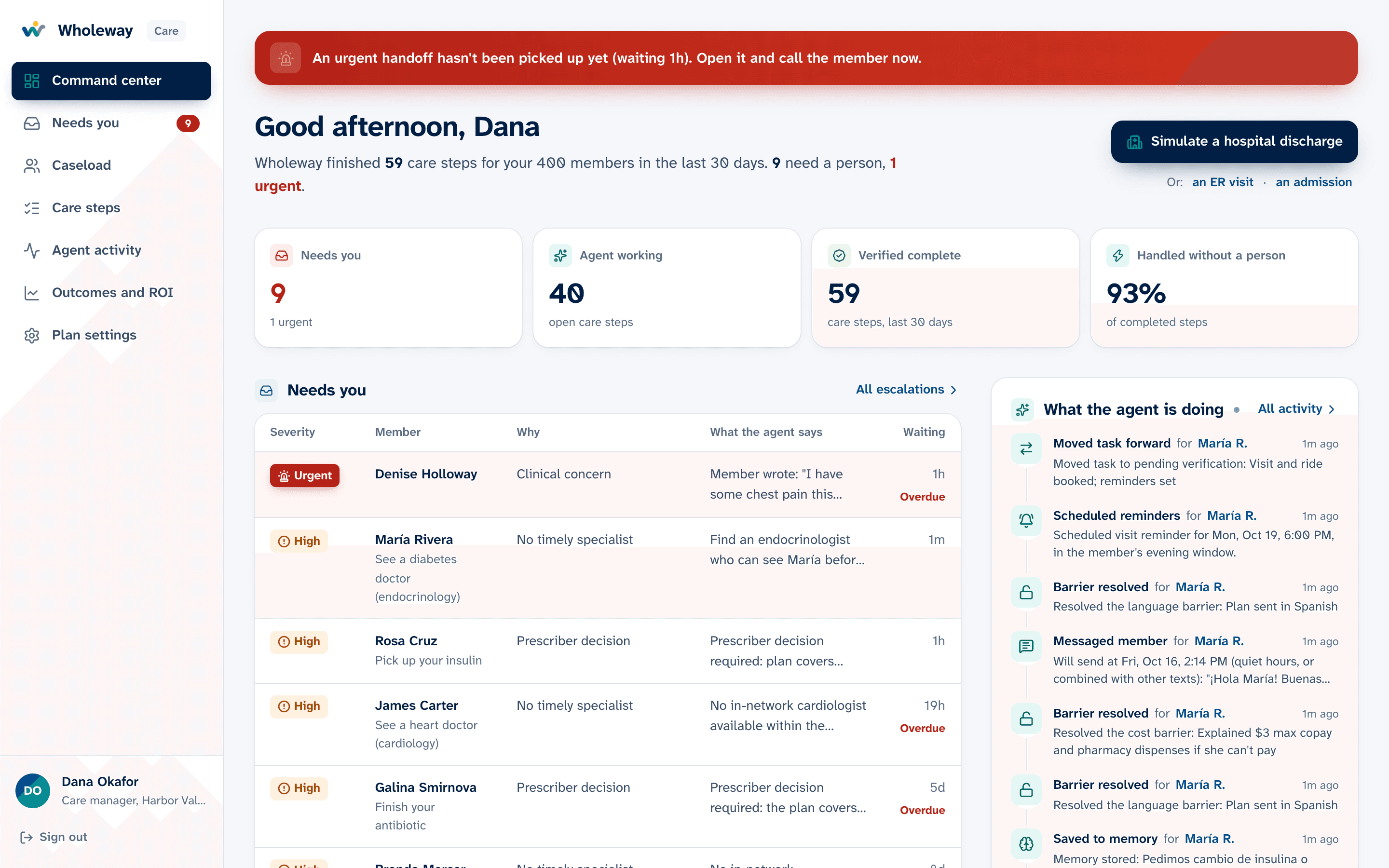
Needs you, first
Urgent and clinical at the top. Every hand-off says what was tried and the one decision left.
Every action explained
What the agent did, when and why, in plain English, on every member's timeline.
Objectives, not tasks
"Get the new insulin", "see the endocrinologist": each with milestones, from discharge to verified.
Product screens show a fictional plan. Every person in them is synthetic.
For members
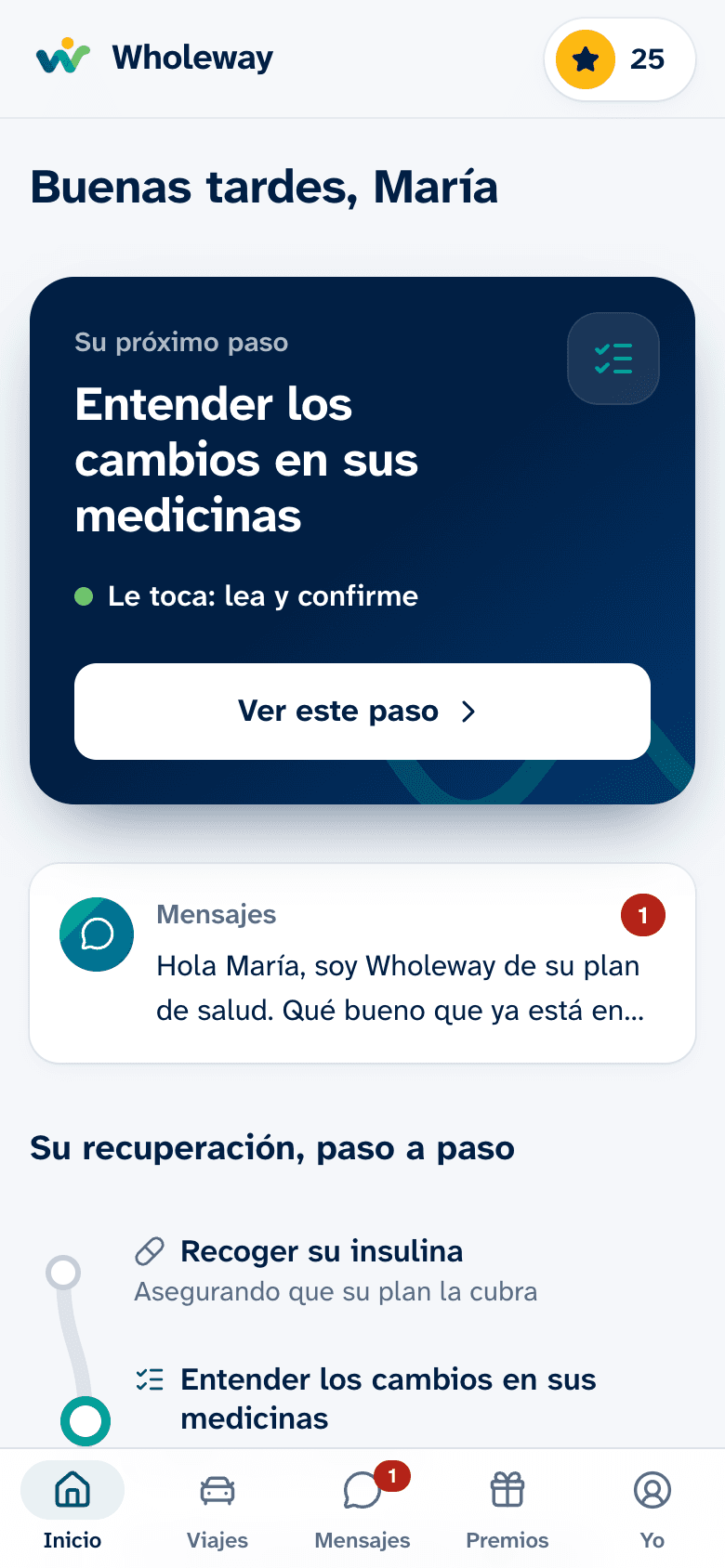
Their next step, in their language, on the phone they already have.
Members don't chase anyone. They see what's happening, what they need to do (usually nothing) and when, and they can answer in their own words.
- Eight languages, written at a 6th-grade reading level
- By text or in the app: no new download, no phone tag
- Points toward gift cards for care they complete
- Symptoms go to a person, with 911 guidance, before any AI

Why it's different
Engagement tools nudge. Wholeway finishes.
| Reminder and referral tools | Wholeway |
|---|---|
| Sends a reminder | Books the visit and the ride |
| Marks the referral "sent" | Tracks it until the visit happens |
| Leaves the barrier to the member | Works coverage, specialists, paperwork, language |
| Counts outreach attempts | Counts care verified on claims, fills and visits |
| Escalates everything, or nothing | Hands a person only the decision, with what was tried |
| English, at a clinical reading level | Eight languages, at a 6th-grade level |
What it's worth
Run the numbers for your members.
The same model the product's Outcomes page uses, with published benchmarks. Savings are credited only where care is completed, and every assumption is shown.
Published unit costs and about two thirds of the randomized-trial effect sizes, applied only where care was completed. Unit costs and utilization from the Commonwealth Fund and AHRQ HCUP; effect sizes from randomized care-transitions trials. Priced at $5 per program member per month.
Estimated net savings a year
$671K
6.6× back for every dollar spent
- Hospital stays avoided
- 62
- ER visits avoided
- 85
- Wholeway cost
- $120K
An estimate from published benchmarks, not a result. In a pilot, the real number comes from claims, against a randomized usual-care group.
How a pilot works
Ninety days to a number your CFO will sign.
We start where it pays first: members leaving the hospital. You keep your care management team; Wholeway takes the work in between.
Weeks 1–2
Connect
- Discharge (ADT) feed, roster and claims
- BAA signed; no PHI before it
- Care team accounts set up, with MFA
Weeks 3–12
Run
- Post-discharge cohort of high-risk members
- A randomized usual-care group held out from day one
- Weekly review of every hand-off with your team
Week 13
Read out
- 7-day follow-up, readmissions and ER visits vs. control
- Cost per verified care step
- Measured from your claims, not our activity
Why now
The work between the plan and the care finally has an owner.
Coverage is fragile again
Since the 2023 Medicaid unwinding, renewal paperwork is one of the most common ways care quietly stops, and every lapse is a member a plan already worked to enroll.
Plans are paid on completed care
Quality measures and state pay-for-performance programs tie plan revenue to follow-up after discharge, readmissions and chronic-disease control.
AI can finally do the work
Agents can now read messy records and act across pharmacy, scheduling and transport systems. The guardrails, not the model, are what make that safe in Medicaid.
Trust
Built for the rules health plans live by.
Every action the agent takes is recorded with its reason, so a care manager, a compliance officer or an auditor can see exactly what happened and why.
Never clinical
A fixed safety screen runs before any AI, in every language. Symptoms and medication questions go to a person immediately.
PHI, protected
Field-level encryption on top of encryption at rest, and an append-only audit log of every record viewed or changed.
No PHI without a BAA
No vendor sees member data without a signed business associate agreement. Demos run on synthetic data only.
Measured against a control
A randomized usual-care group, and savings credited only for verified care, with every assumption editable.

Our mission
Every Medicaid member should get the care their plan already promised them.
The plan is written. The benefit is covered. What's missing is someone to do the work in between, for every member, every time, in their language. That's what we build.
Get started
Bring Wholeway to your members.
We start with post-discharge care for high-risk members, where 7-day follow-up and readmissions are what plans are measured on. Tell us about your program, and we'll show you the agent working your barriers.